



Use the syllabus as your checklist:
Print out the syllabus and keep it beside you while revising.
Colour-code each topic based on how confident you feel:
| Colour | Confidence level | What to do |
|---|---|---|
| Red | Difficult | Prioritise these topics first |
| Orange | Medium | Review after the red topics |
| Green | Confident | Revisit closer to the exam |
Try to work through the syllabus in that order: red first, then orange, then green.
Practice tests and past papers
Past papers should be a major part of your revision and start using them early! (minimum 2-3 weeks before exam)
When I was preparing for my exams, I worked through papers from 2010–2022. That was probably excessive, but it helped me a lot.
Try to:
- complete questions without looking at your notes
- use timed conditions when possible
- mark your answers carefully
- note down the topics you keep losing marks on
- return to those topics before attempting another paper
A really useful habit is to take a picture of every past-paper question you get wrong and keep them all in one album on your phone.
Go through the album regularly, especially before bed. This helps you keep seeing the questions you struggled with so you are less likely to make the same mistake again.
The aim is not just to complete as many papers as possible. The important part is learning from your mistakes.
Also, write down next to the questions why you got each question wrong. I would literally write next to a question, “I got this question wrong because I forgot to look at the units.”
It sounds a bit extreme and honestly a little stupid, but it really helped me stop making the same mistakes over and over again. After a few papers, you start noticing patterns, whether it is forgetting units, missing a key word, misreading the question or not showing enough working. Once you know what your common mistakes are, they become much easier to avoid.
Write more points than the question is worth
If a question is worth 3 marks, I would usually write 4–5 separate points rather than stopping after exactly three. The examiner will keep reading your answer and award marks for the correct points until you reach the maximum available.
I found this especially helpful because sometimes one of the points I thought was correct was not actually on the mark scheme, but one of my extra points was. So instead of relying on exactly three answers being right, I gave myself a little bit of a safety net.
Pay attention to exam command words when doing past papers
Make sure you understand exactly what the question is asking you to do. Words like describe, explain, compare, calculate, suggest and evaluate all require slightly different types of answers. A lot of marks can be lost not because you do not know the content, but because you have not answered the question in the way the examiner wants. When you mark your past papers, pay attention to the command word and compare your answer with the mark scheme so you can get used to the wording expected in the exam.
You do not need to feel completely confident before starting exam questions. Exam questions are part of the revision process, and the mistakes you make while practising show you what to work on before the real exam. I went from getting like 20/40 in each past paper to 35-40/40 over 2 weeks.
Active recall methods:
Active recall means testing yourself without looking at your notes first. It is much more useful than repeatedly rereading or highlighting. I actually built a routine that used a bit of each method and always stuck to it.
Flashcards - my FAV
Write a question or prompt on the front and the answer on the back.
You can use Anki, Quizlet or physical flashcards.
The important part is to answer the question before checking the back.
Example
Question: What is the function of mitochondria?
Answer: They are the site of aerobic respiration and ATP production.
Question-based notes - make sure all your flashcards are questions btw
Instead of writing notes only as statements, turn them into questions.
For example:
Statement: Insulin lowers blood glucose levels.
Question: How does insulin lower blood glucose levels?
When you review your notes later, cover the answer and try to recall it first.
The blurting method - my second FAV
- Read through a section of content.
- Close your notes.
- Write down everything you can remember on a blank page or white board.
- Open your notes and compare.
- Add anything you missed and correct any mistakes.
The points you forgot should become your focus during the next revision session.
The Feynman technique - I did this with my whiteboard along with blurting method
Choose a topic and explain it out loud as if you were teaching it to someone who has never studied it before.
Keep your explanation simple.
If you struggle to explain part of the topic clearly, go back to your notes, review that section and then try again.
This is a good way to identify gaps in your understanding.
Blank-sheet mind mapping/ Summaries - I did this in first year and it was so nice to have a one page summary for everything at the end of second year.
These are the only ‘notes’ you should be taking before your exam.
Start with a blank sheet of paper and write the main topic in the centre.
From memory, add branches for everything you can remember.
For example, for photosynthesis, you might include:
- equation
- chloroplasts
- limiting factors
- light intensity
- carbon dioxide
- temperature
- required practicals
Once you are finished, compare the mind map with your notes and add anything you missed. Now, you have one page topic summaries to look back at before you start doing past papers or before bed.
A simple revision routine for exams
A good revision session could look like this:
Step 1: Choose a weak topic
Start with something marked red on your syllabus checklist.
Step 2: Review the content
Use very visual resources: videos, mind maps, summaries or fun slides. NO TEXTBOOK OR NOTES
Step 3: Test yourself -using a whiteboard
Use blurting, flashcards, question-based notes or the Feynman technique.
Step 4: Complete exam questions
Find questions specifically on that topic.
Step 5: Mark your work
Use the mark scheme and identify exactly where you lost marks.
Step 6: Review your mistakes
Go back over anything you got wrong.
Step 7: Update your checklist
As your confidence improves, move topics from red to orange and then to green.
If you are studying for exams try to build a routine with a specific start time and process that you repeat throughout the day to avoid burn out. Try to stick to the same revision routine every day, even if it starts to feel repetitive. I found that having a set order helped me stay consistent and made it easier to get started.
For example, I always started my day with Chemistry because it was the subject I hated the most, then I did Biology after lunch, and I ended the day with Maths.
I also always reviewed the content first before starting past-paper questions. That way, I was not going into the questions completely cold, but I was still using the past papers to test whether I had actually understood and remembered the topic.
It can get boring doing the same process over and over again, but that consistency is where I personally saw the most improvement.
The Revision Routine I used:
I actually built a routine that combined a little bit of each method, and I tried to follow the same process every time I revised a topic. Having a set routine meant I did not waste time deciding how to study.
1. Watch a Crash Course video
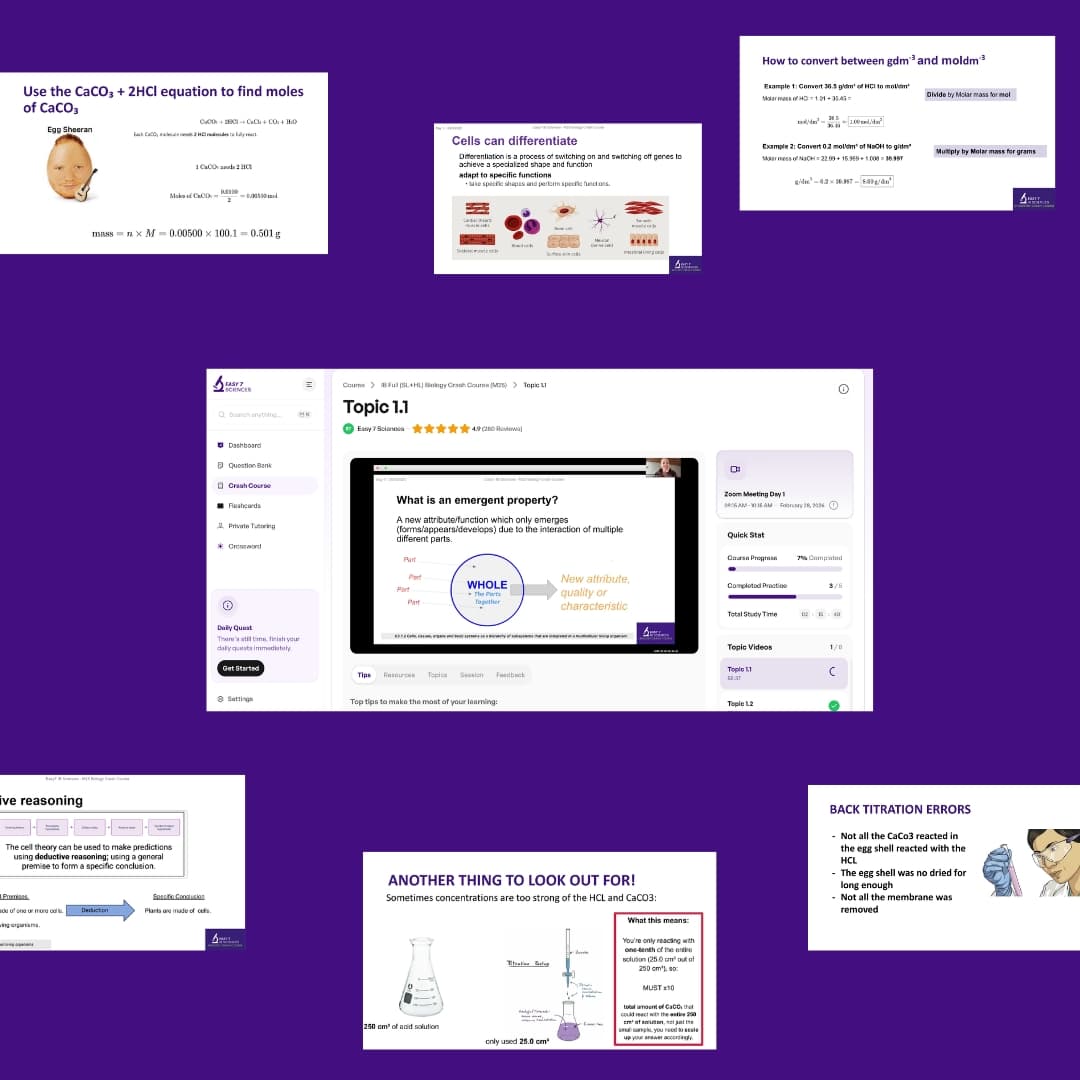
I would start by watching a Crash Course video on the topic. This gave me a quick, visual overview and helped me understand the bigger picture before trying to memorise all the details.
2. Go through flashcards for the whole topic
Once I understood the topic, I would go through all my flashcards. I made sure they were written as questions so I had to actively recall the answer rather than just read information.
3. Do a big whiteboard summary from memory
After the flashcards, I would close everything and use a whiteboard to write out as much of the topic as I could remember. I would combine blurting with the Feynman technique by explaining things out loud while writing them down.
Then I would compare my whiteboard with my resources, fill in anything I had missed and take a picture of the finished whiteboard. I saved these pictures on my phone, so by the time exams came around I had a whole collection of quick topic summaries that I could easily look through.
4. Move straight into past-paper questions
Once I had reviewed and actively recalled the content, I would start doing past-paper questions on that topic. This was where I could actually see whether I understood the content well enough to apply it.
5. Mark everything and learn from the mistakes
I would mark my answers properly and look at exactly why I had lost each mark. If I got a question wrong, I would take a picture of it and add it to my mistakes album so I could review it again later.
Then I would repeat the exact same process for the next topic.
Video → Flashcards → Whiteboard → Past papers → Review mistakes
It definitely became repetitive, but that was kind of the point. Once I found a method that worked for me, I stopped constantly changing how I revised and just repeated the same routine. That consistency helped me much more than trying a new study technique every few days.
Hanin Kandeil - Easy7 Crash Course Co-Lead tutor
Please email me if you are interested in private tutoring!